


Japan backs US$496 million HVDC financing for India's transmission expansion
Japan's Sumitomo Mitsui Banking Corp, Kansai Mirai Bank, and the state-backed Japan Bank for International Cooperation are arranging nearly US$496 million in syndicated financing for a high-voltage direct current transmission project being built by Power Grid Corporation of India, targeted for completion in 2029.
The financing marks the first project under POWERR Asia, a regional energy-security framework unveiled earlier this year by Japan's government at the height of the Strait of Hormuz crisis, signalling that Tokyo now views Indian grid infrastructure as strategically linked to its own energy resilience.
What makes this significant is less the sum than the bottleneck it targets. India's renewable capacity has expanded faster than its transmission network can absorb, and grid constraints accounted for roughly two-thirds of all clean-energy curtailment recorded in the first quarter of this year.
Sharp growth in solar and wind has pushed their combined share past half of India's installed power capacity, but without matching HVDC and transmission upgrades, that capacity risks sitting idle at peak generation hours.
The deal also formalises a financing pattern that could be repeated: sovereign-linked Japanese capital underwriting Indian grid assets rather than generation or storage projects, which have so far dominated foreign investment interest.
For India's power sector, that distinction matters — transmission has historically been harder to finance externally than generation, given longer payback horizons and state-utility counterparty risk.
If POWERR Asia scales beyond this single project, it could open a new channel for concessional infrastructure capital aimed at unclogging the grid rather than adding more renewable capacity to a system already struggling to absorb what exists.
(Source: OilPrice.com)
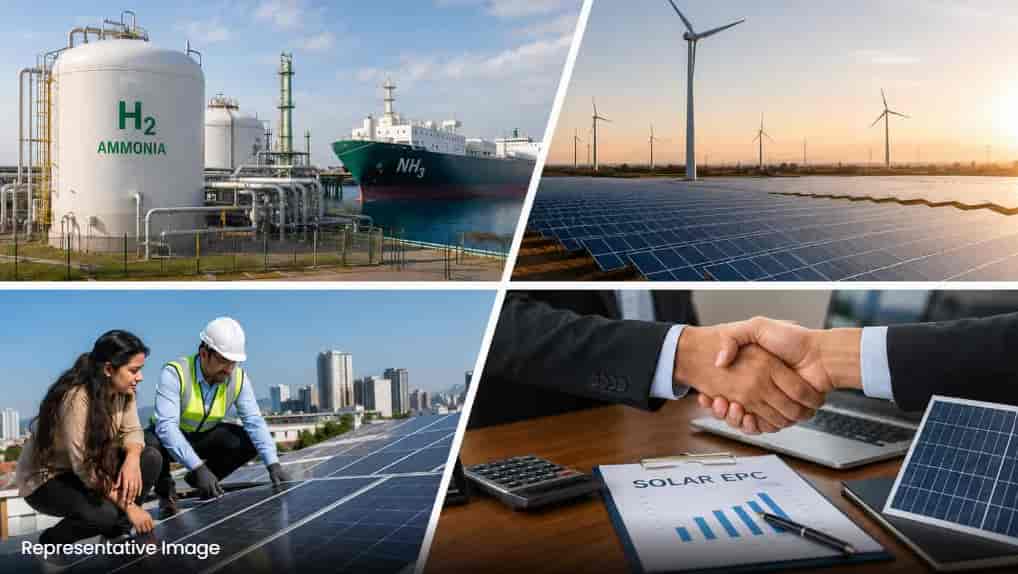
ACME, Mitsubishi sign US$1 billion green methanol export pact from Odisha
ACME Group's Green Molecules Business has signed a binding long-term agreement with Japan's Mitsubishi Gas Chemical Company to supply 100,000 tonnes of green methanol annually, valued at roughly $1 billion.
The fuel will be produced at ACME's under-construction Paradip facility in Odisha and is designed to meet the European Union's RFNBO standard and forthcoming International Maritime Organization rules — making it India's first global collaboration for compliant green marine fuel.
The deal is distinct from, though adjacent to, ACME's existing ammonia partnership with Japan's IHI Corporation at the same Odisha hub.
While that arrangement addresses ammonia for power and industrial use, this one targets shipping decarbonisation specifically, diversifying ACME's green-molecule portfolio across two separate Japanese offtake relationships and two end markets. Paradip is now ACME's third major investment in Odisha, reinforcing the state's emergence — alongside Gujarat — as India's principal green-fuel export coast.
Structurally, the agreement matters because global shipping decarbonisation has lacked bankable Asian supply until now. Green methanol remains compatible with existing port and vessel infrastructure with only modest retrofitting, thereby lowering switching costs for shipowners relative to ammonia- or hydrogen-based alternatives.
A committed offtaker in Mitsubishi Gas Chemical gives ACME the long-term revenue visibility needed to justify capital-intensive electrolyser and synthesis capacity before first production, following a financing logic increasingly common in India's green hydrogen derivatives sector — long-term offtake certainty substituting for domestic subsidy support that has been slow to materialise.
(Source: Energetica India)
Premier Energies' ₹6,000 crore solar manufacturing bet targets 2028 localisation
Premier Energies plans to invest approximately ₹6,000 crore (US$630 million) over three years to build 10 GW of ingot and 10 GW of wafer manufacturing capacity in Andhra Pradesh, according to the company's Chief Business Officer.
The investment is part of a broader ₹12,500 crore (US$1.3 billion) capex programme that also doubles cell capacity to 10.6 GW, expands module capacity to 11.1 GW, and pushes the company into inverters, batteries and transformers.
The timing is policy-driven rather than opportunistic. India's Ministry of New and Renewable Energy has extended its Approved List of Models and Manufacturers framework to cover ingots and wafers from June 2028, meaning all such components consumed domestically will need to be locally made from that date.
Premier Energies' investment effectively pre-positions the company ahead of a hard localisation deadline, rather than responding to near-term demand signals — a markedly different investment logic from most solar capacity announcements, which tend to track auction pipelines rather than regulatory mandates years in advance.
Full backward integration — from ingot through to finished module — has so far been rare in Indian solar manufacturing, which has largely built cell and module capacity while continuing to import upstream wafers, mostly from China.
If Premier Energies executes this successfully, it would mark one of the first genuinely integrated Indian solar supply chains, reducing dependence on China at a stage where Chinese manufacturers currently hold the deepest cost advantage.
It is also a signal to the rest of the sector: with a 2028 deadline now fixed, other Indian cell and module makers face the same backwards-integration choice, and the capital intensity involved may accelerate consolidation among smaller players unable to fund the upstream build-out themselves.
(Source: The Print / PTI)
Adani Enterprises raises ₹15,000 crore through upsized QIP
Adani Enterprises has increased the size of its qualified institutional placement to ₹15,000 crore (US$1.57 billion), up from the initially planned ₹10,000 crore, according to NSE disclosures.
The upsizing reflects strong institutional investor demand, allowing the flagship Adani entity to expand the raise mid-process rather than close it at the originally planned size.
The scale of the increase is the key point here. A near-50% upsizing in a qualified institutional placement generally signals that anchor and institutional demand materially exceeded the base offer, which — for a conglomerate that has faced periodic scrutiny over disclosure and governance in recent years — is a meaningful market-access signal.
Equity capital raised through a QIP is unencumbered by the pledge and collateral structures that have previously drawn scrutiny in Adani Group’s financing, making this a comparatively clean instrument for the group to raise growth or deleveraging capital.
For India's broader corporate financing landscape, the raise also underscores how domestic and international institutional capital continues to differentiate between Adani Group entities and the group's headline-level risk.
Enterprises have functioned as the group's incubator for new businesses — including green hydrogen, airports and data centres — and a larger equity cushion gives it more flexibility to fund these capital-intensive bets without resorting to additional group-level debt, a structural priority for Adani since the market turbulence of recent years.
(Source: Reuters via Yahoo Finance)