
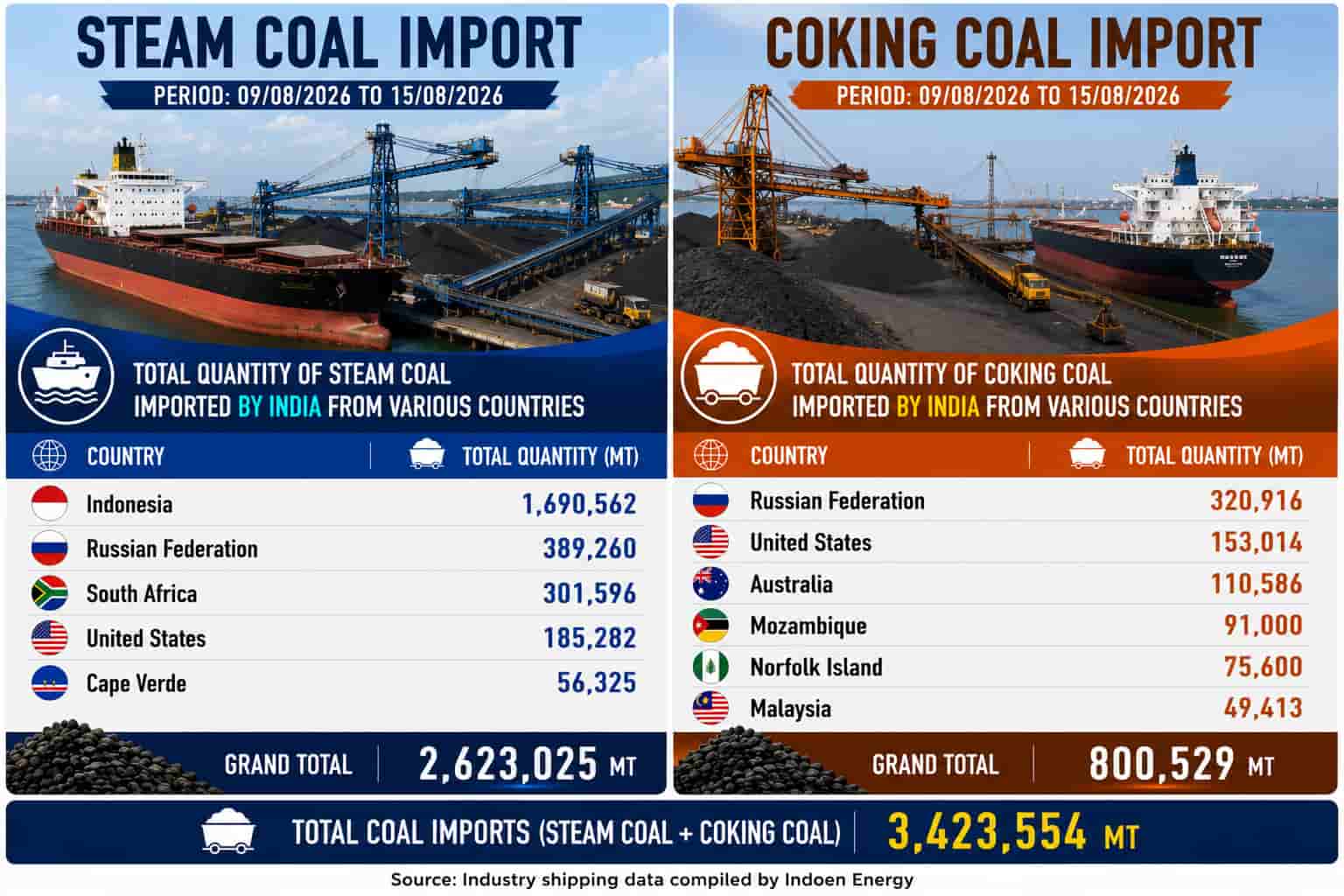
India's coal imports moderated during 9–15 August 2026, with total shipments falling to 3.42 million tonnes (MT) from 3.56 MT in the previous week, a decline of about 3.9%.
The headline number, however, masks a sharp divergence between the two categories. Steam coal imports rose 12.4% to 2.62 MT, led by Indonesia with 1.69 MT, while coking coal imports plunged 34.9% to 0.80 MT.
Russia was the largest coking-coal supplier at 0.32 MT, followed by the US at 0.15 MT and Australia at 0.11 MT. The data points to continued thermal-coal requirements even as steel-sector procurement appears to have slowed.
The wider Indian coal market is showing the same tension between strong underlying demand and rising domestic availability. July coal production reached 69.75 MT, up 7.51% year-on-year, while recent government data indicates substantial coal availability for the power sector.
At the same time, non-coking coal imports increased 2% year-on-year in July, the first annual increase in 2026, suggesting that import demand can still respond quickly to supply or logistics constraints despite efforts to reduce overseas dependence.
Globally, coal markets remain divided. Asian thermal-coal imports have been recovering, particularly in China, Japan and South Korea, while India's import trajectory has been comparatively restrained.
This divergence reflects differences in domestic production, stock levels and renewable generation. In the metallurgical market, Australian coking-coal exports increased 2.7% year-on-year during January–July, even as prices weakened: high-quality Australian coking coal was around US$214.9/t on 7 August, down 10% from a month earlier.
The most significant longer-term development for India is the continuing expansion of planned coal-mining capacity even as the country's clean-energy buildout accelerates. A recent Global Energy Monitor assessment found India was a major contributor to the global increase in proposed coal-mining capacity.
At the same time, Reuters reported that India's clean-energy capacity had reached 331.7 GW, exceeding its 302 GW of fossil-fuel capacity. The latest import figures therefore underline an increasingly complex coal market: thermal coal remains essential for reliability, while coking coal demand is more closely tied to steel cycles and international prices.
Follow us on : X | LinkedIn | Facebook | Bluesky