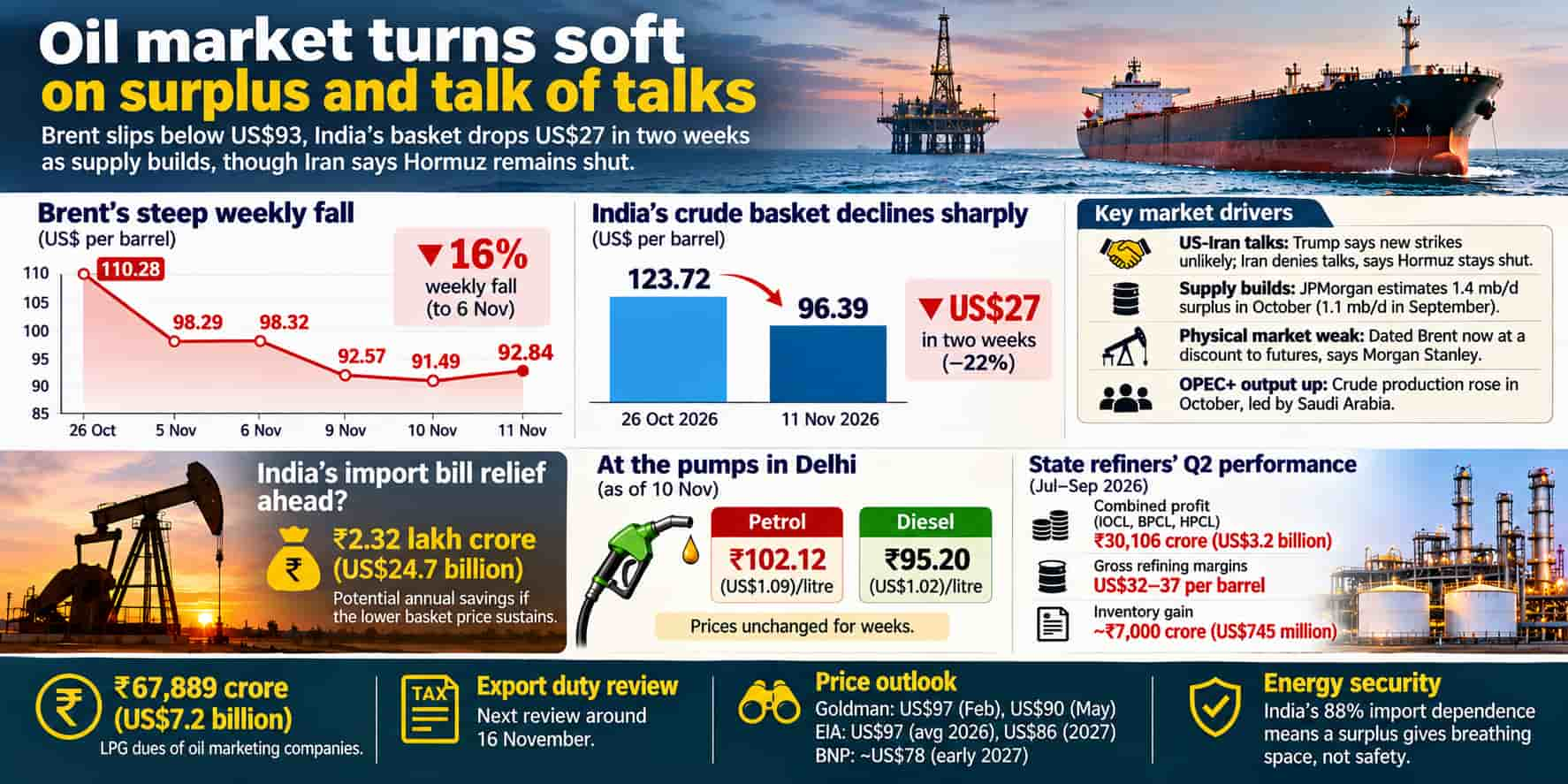
Brent futures fell 16% in the week to 6 November, the steepest weekly drop since early 2020. They settled at US$98.29 on 5 November and US$98.32 on 6 November.
On 8 November, President Trump said he was highly unlikely to order fresh attacks on Iran while talks continue. Iran claimed attacks on three tankers the same day. On 9 November, Brent settled at US$92.57, the lowest since late August.
On 10 November, Brent briefly fell below US$90 and settled at US$91.49. Iran’s Revolutionary Guards said three tankers hit mines that day. On 11 November, Brent settled at US$92.84. Iran’s security chief Mohsen Rezaei said no talks are under way and that Hormuz stays shut until Washington meets seven conditions. A media report said Vice President Vance is considering meeting him. The two sides’ accounts conflict.
The physical market tells a second story. Morgan Stanley said on 9 November that Dated Brent, the price of physical North Sea cargoes for near-term delivery, has fallen to a discount to futures. Two weeks earlier it traded well above them.
JPMorgan estimates a surplus of 1.1 million barrels a day in September and 1.4 million in October. UBS pointed to recovering Middle East flows, rising output elsewhere and weak demand. OPEC+ crude output also rose in October, led by Saudi Arabia.
“Paper prices fell on politics, but the physical discount shows the market is oversupplied for now,” said an analyst tracking global crude markets. For India, each US$1 on the basket is worth about ₹8,578 crore (USUS$915m) a year.
The basket falls faster than Brent
India’s basket fell to US$96.39 on 11 November from US$123.72 on 26 October, as per aggregated price data, a drop of about US$27. If sustained, that would cut the annual import bill by about ₹2.32 lakh crore (USUS$24.7 billion).
The premium over Brent futures has shrunk to about US$4-5, from US$12-14 in mid-October. Physical grades led the fall. Saudi Arab Light was assessed near US$82.55 on 11 November, about US$10 below futures.
The rupee closed at ₹93.69 on 11 November, its strongest in over six months, up from ₹94.58 on 4 November, on cheaper crude and foreign inflows. Axis Bank Research still expects ₹100 per dollar by June 2027.
 Pumps frozen, profits flattered
Delhi petrol is ₹102.12 (USUS$1.09) a litre and diesel ₹95.20 (USUS$1.02) as of 10 November, unchanged for weeks. Cheaper crude should narrow marketing losses.
Results reported between 22 October and 1 November show an uneven year. Indian Oil, Bharat Petroleum and Hindustan Petroleum posted a combined July-September profit of ₹30,106 crore (USUS$3.2 billion), on gross refining margins of US$32-37 a barrel. That included an inventory gain of about ₹7,000 crore (USUS$745m). LPG dues stand at ₹67,889 crore (USUS$7.2 billion).
“Part of our profit was inventory gain, and that reverses when crude falls this fast,” said an executive at a leading Indian refiner.
Export duty review due
The special additional excise duty on exports has stood since 31 October at ₹11.5 a litre (USUS$0.12) on diesel and ₹11 (USUS$0.12) on aviation turbine fuel (ATF), with none on petrol. The next fortnightly review is due around 16 November. Lower product prices could bring lower rates.
Where forecasters see prices heading
Near term, forecasts are being trimmed. The US Energy Information Administration (EIA) expects Brent spot near US$100 in November and December, but it finalised its inputs on 5 November, before Brent fell below US$93. Goldman Sachs now sees US$97 in February and US$90 in May, while Morgan Stanley still sees US$100 in the first quarter of 2027.
Long term, the EIA expects Brent to average US$97 in 2026 and US$86 in 2027, easing to US$77 in the fourth quarter of 2027 as stocks rebuild. It assumes Middle East output recovers, with Iranian exports still constrained. Goldman sees US$79 in twelve months, and BNP expects about US$78 in early 2027.
What it means for energy security
India’s 88% import dependence means a surplus gives breathing space, not safety. Iran says Hormuz stays shut, and mines hit tankers again on 10 November. The next checkpoints are the export duty review around 16 November and OPEC+’s ministerial meeting on 29 November.