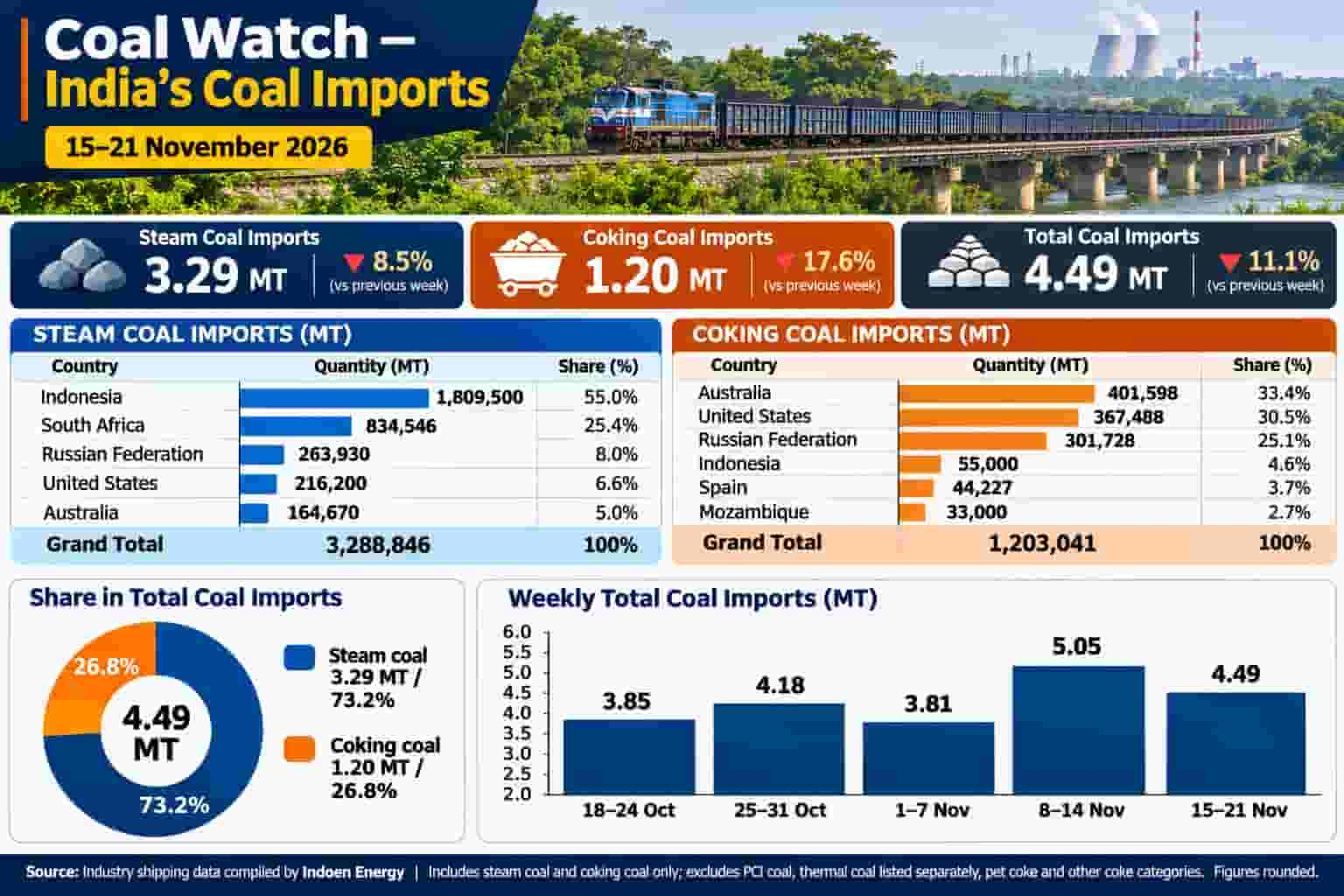


India’s coal imports declined 11.1% week-on-week to 4.49 MT during 15–21 November, reversing the sharp increase recorded in the previous week. Both major categories weakened. Steam coal imports fell 8.5% to 3.29 MT, while coking coal shipments dropped 17.6% to 1.20 MT.
Indonesia remained the largest supplier of steam coal, accounting for 1.81 MT, or 55% of weekly arrivals. South Africa contributed 0.83 MT, followed by Russia at 0.26 MT and the United States at 0.22 MT. In coking coal, Australia supplied 0.40 MT, narrowly ahead of the United States at 0.37 MT and Russia at 0.30 MT. The three countries together accounted for nearly 89% of coking coal imports.
Domestic inventory conditions provide an important explanation for the continued sensitivity of thermal imports.
The Central Electricity Authority's 19 November stock report put coal inventories at power plants at 24.20 MT, against a normative requirement of 64.26 MT. Stocks represented just 37% of the prescribed level, while 71 plants were classified as having critically low inventories. Daily consumption across operating plants was approximately 3.13 MT.
An earlier assessment by CRISIL had found that power plants held around 20 MT on 31 October, equivalent to only six days of consumption, compared with 16 days a year earlier. It also reported that 86 of 191 plants had stocks below 25% of their normative requirements. This suggests that domestic dispatches have not yet fully restored inventory buffers despite stronger supply efforts.
The steel sector offers a contrasting demand signal for coking coal. According to the Ministry of Steel, finished steel consumption reached 99.3 MT during April–October FY27, up 7.5% year-on-year. Crude steel production increased 2.6% to 99.1 MT. Finished steel imports also rose 28.9% to 4.90 MT during the seven-month period, indicating a changing trade balance even as domestic consumption expanded.
Government data also point to efforts to reduce import dependence. India's total coal imports fell 5.83% year-on-year to 104.57 MT in August 2026. Coking coal imports declined 4.18% to 27.30 MT, while imports for blending at domestic coal-based power plants fell 35.23%. However, these monthly figures should not be read as a direct explanation of its weekly movement.
The week therefore reflects a broad-based weekly correction rather than evidence of a structural decline in coal requirements. Thermal imports remain exposed to domestic stock and logistics constraints, while coking coal procurement continues to track the requirements of an expanding steel market. The next few weeks will indicate whether the decline is temporary or the beginning of a sustained moderation in seaborne arrivals.